


If you look at today’s tech market, one thing is crystal clear: Amazon cloud business growth is absolutely on fire. “AWS has moved beyond being just a service to becoming the backbone of the global digital economy. Q1 2026 data shows that AWS delivered massive growth of 28%, its best performance in the last 15 quarters.” But behind this success story lies a complex dynamic—maintaining Amazon cloud business growth is requiring the company to make record-breaking capital expenditures. When we talk about Amazon cloud business growth, investors focus on whether this heavy investment will yield long-term profits or will just become a short-term cash burn.

From Infrastructure to Intelligence: Inside Amazon’s $20B AI Hardware Strategy

Amazon CEO Andy Jassy has made it clear that this infrastructure investment is a “once-in-a-lifetime” opportunity. The demand for AI (Artificial Intelligence) is so high that the company is betting billions of dollars on land, power, and advanced chips (like Trainium and NVIDIA GPUs) to sustain Amazon cloud business growth. This isn’t normal expansion; it’s a “paradigm shift.” Amazon’s chips business has now crossed a $20 billion revenue run rate, which shows that their hardware investment strategy is going in the right direction.
The Price of Innovation: Balancing Today’s Capital Burn for Tomorrow’s Cloud Empire
Many people ask, “If profits are growing so much, why is free cash flow decreasing?” The answer is simple: infrastructure for Amazon cloud business growth has to be built first, and the revenue comes later. When Amazon plans up to $200 billion in capex (capital expenditure), it’s not just building data centers, it’s designing the internet platform of the future. Investor perception suggests that when Amazon cloud business growth is so rapid, it’s essential to scale up infrastructure, even if it puts temporary pressure on free cash flow.
Building the Unbreachable Moat: Why Amazon’s Integration Strategy Still Leads the Cloud Wars
Competition with Azure and Google Cloud is fierce. However, the secret to Amazon’s cloud business growth lies in its deep integration. Enterprise customers don’t just want servers; they want secure, scalable, and agentic AI workloads. By leveraging tools like Amazon Bedrock and Kiro, Amazon has doubled its developer base. This technical moat keeps them the market leader. As long as Amazon’s cloud business growth momentum continues, this infrastructure spend will remain a strategic necessity.
Beyond the Capex Cycle: When Will Amazon’s Massive Investments Start Paying Off?
According to expert analysis, the period 2026-2027 is going to be crucial. Amazon has made major commitments to players like Anthropic and OpenAI, who will utilize their compute capacity. This means that the “surging spend” we see today is going to become “guaranteed revenue” tomorrow. If you look at the metrics of Amazon cloud business growth, it is clear that the most expensive phase of the scale-up process is currently underway. Once these data centers and GPU clusters start working at full capacity, operating margins will improve significantly.
Beyond Capex: The Vertical Integration Moat
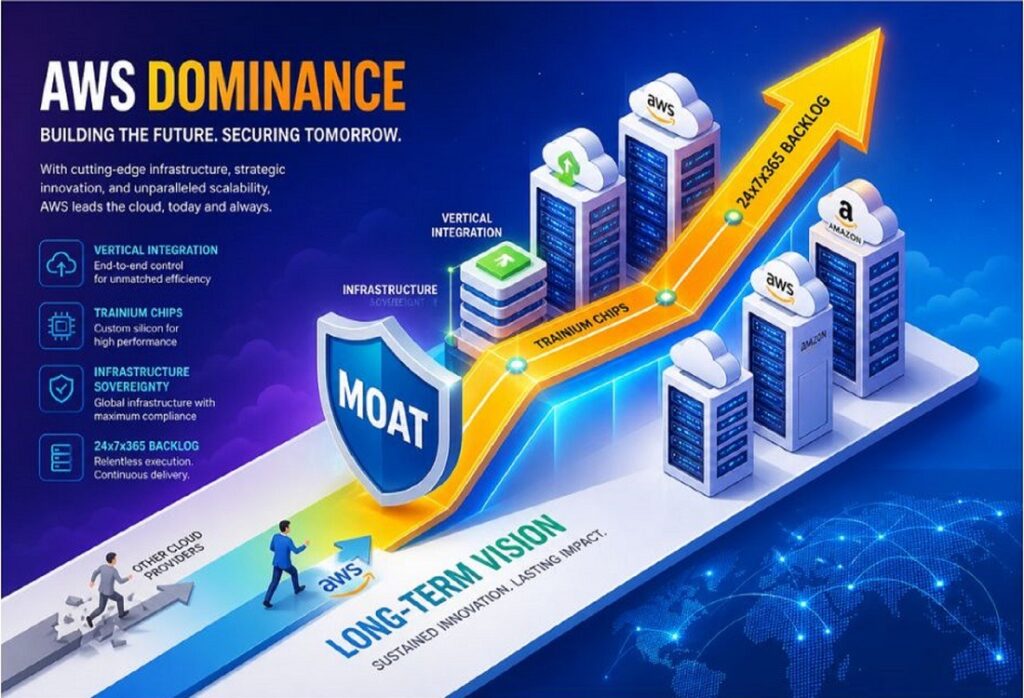
“If we analyze the financial impact of this investment deeply, it is clear that Amazon is pursuing a ‘vertical integration’ strategy. Instead of just buying chips from outside, Amazon is developing its own Trainium and Graviton chips, which help them to be less dependent on third-party providers like NVIDIA. This is not just cost-cutting, but a major move to achieve ‘infrastructure sovereignty’. When Amazon designs its own data centers and chips, the efficiency margin of their Amazon cloud business growth becomes much better than competitors in the long term. Investors should understand that this $200 billion capex is no This isn’t a ‘sunk cost’, but rather a ‘moat’ (fortress) that will make AWS invincible in the coming AI-driven decade. When you consider that their revenue backlog exceeds $244 billion, it becomes clear that this investment isn’t just hype, but based on solid customer demand.”
Strategic Insights for Investors
Investors must understand the difference between “short-term and long-term.” If you just look at quarterly free cash flow, you might think Amazon is overspending. But if you look at the underlying demand drivers of Amazon cloud business growth—such as triple-digit growth in the chips business—you’ll see that management is future-proofing. This “capital-intensive” phase puts Amazon ahead of any competitor that can’t scale as quickly.
The Road Ahead: Why Amazon’s AI-Driven Infrastructure Will Define the Future of Cloud
To sum it up, Amazon stands at a crossroads where innovation and investment have become complementary to each other. The future of Amazon cloud business growth depends not just on servers, but on the entire ecosystem that AWS has created. Industry experts believe that as AI workloads mature, the trajectory of Amazon cloud business growth will become even steeper.
In this race, the companies that get the infrastructure ready first will dominate the market. This “aggressive spending” model of Amazon may seem risky, but history shows that they have always given priority to the “long-term vision”. So, over the next few quarters, be sure to keep an eye on Amazon’s cloud business growth numbers, as they will determine whether this massive investment gamble pays off. With investments with Anthropic and global data center expansions, Amazon is now not just a cloud provider, but the kingpin of AI infrastructure. Ultimately, Amazon’s cloud business growth is the engine that will keep Amazon on top in 2026 and beyond.
DISCLAIMER: This blog post is intended for educational and informational purposes only. The information provided herein should not be construed as financial or investment advice. Investing in Amazon (AMZN) or any other stocks involves risk. Please conduct your own research (DYOR) and consult with a qualified financial advisor before making any investment decisions.
